VATICAN - Senior Roman Catholic and Lutheran officials announced on Monday they would mark the 500th anniversary of the Reformation in 2017 as a shared event rather than highlight the clash that split Western Christianity.
UK - Girls will no longer have to pledge their devotion to God when they join the Guides and Brownies in the UK. It comes after a consultation found a new Girlguiding UK promise was needed to include "more explicitly" non-religious and those of other faiths.
GERMANY - Is Barack Obama a friend? Revelations about his government's vast spying program call that assumption into doubt. The European Union must protect the Continent from America's reach for omnipotence.
UK - Prime Minister David Cameron has announced plans for what could be "the biggest bilateral trade deal in history" between the EU and the US.
RUSSIA/USA - Russian President Vladimir Putin and US President Barack Obama have agreed to push the sides of the ongoing Syrian conflict to the negotiating table in Geneva. The leaders made the pledge after a 2 hour meeting at the G8 summit.
TEHRAN, IRAN - Iran's newly elected president showcased his reform-leaning image Monday by promising a "path of moderation" that includes greater openness on Tehran's nuclear program and overtures to Washington. He also made clear where he draws the line: No halt to uranium enrichment and no direct US dialogue without a pledge to stay out of Iranian affairs.
TURKEY - Turkey has said it may bring in the army to help end nearly three weeks of nationwide anti-government protests. The warning came as two major union federations went on strike on Monday over police violence against demonstrators.
UK - About 20 of the UK's leading scientists and meteorologists are due to meet at the Met Office to discuss Britain's "unusual" weather patterns. They will try to identify the factors that caused the chilly winter of 2010-11 and the long, wet summer of 2012.
SYRIA - Western leaders criticized Russian President Vladimir Putin for supporting Syria’s Bashar al-Assad in his battle to crush a two-year-old uprising, setting the stage for what could be a difficult meeting of world leaders over Monday and Tuesday.
USA - Almost three years ago we first highlighted the real math behind the surging entitlement class that America has become. So why does a large portion of the population choose not to work when there are many jobs available?
EUROPE - While we have been told vehemently that the Cypriot deposit confiscation was not a template, yet another European nation is embarking on an until-now-considered-safe asset class to recapitalize its banks.
USA - When a National Security Agency contractor revealed top-secret details this month on the government's collection of Americans' phone and Internet records, one select group of intelligence veterans breathed a sigh of relief.
GERMANY - In June 1963 John Kennedy brought hope to a divided city at the frontline of the cold war with the words “Ich bin ein Berliner”. When Barack Obama visits Berlin next week, half a century later, he will find it a very different place. United, strong and rich, Germany is Europe’s hegemonic power.
GERMANY - From the football pitch to politics to the economy, Germany has become Europe’s most powerful country. Described by this newspaper as the sick man of Europe in 1999, Germany now appears to have the continent’s strongest as well as its biggest economy.
ITALY - Three different models for regional unification have been proposed by the movement for European integration since its inception. One vision is a league of states that preserve national sovereignty while committing themselves to follow specific policies agreed by consensus.
Disclaimer:
The views expressed in this section are not our own, unless specifically stated, but are provided to highlight what may prove to be prophetically relevant material appearing in the media.
“Just what is an APOSTLE?”
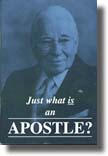
Today we find the Church of God in a “wilderness of religious confusion!”
The confusion is not merely around the Church – within the religions of the world outside – but WITHIN the very heart of The True Church itself!
Read online or contact email to request a copy