USA - Robots, called LAWS – lethal autonomous weapons systems – will be able to kill without human intervention. Killer robots which are being developed by the US military ‘will leave humans utterly defenceless‘, an academic has warned.
VATICAN - The bank, officially called the Institute for Religious Works, earned €69.3 million last year. Once tainted by scandal and intrigue, the Vatican bank has managed to increase its profits by more than 20 times since embarking on a comprehensive drive for transparency and accountability ordered by Pope Francis. Under the root-and-branch reform that was ordered by Pope Francis shortly after he was elected in early 2013, the bank has closed down more than 4,500 accounts. Around 550 were shut down after it was deemed that their holders did not meet new, stricter criteria regarding tax evasion, money-laundering and transparency. The pontiff has made reforming the bank, which in the past was tainted by allegations of financial skulduggery, one of the priorities of his papacy.
USA - The term “fat Americans” has become synonymous with overweight tourists, and other cultures mock us for our apparent sloth. But could there be more to this than just the fact that we eat too much? Could it be possible that we have been fattened up by design? Why doesn’t the medical establishment do more to help us lose weight and keep it off?
EUROPE - Is the world going mad? Military posturing is quietly reaching new extremes in Europe, the Mediterranean and the South China Sea. And the provocative bluster has just reached new heights. The source was anonymous. But the mouthpiece has a measure of credibility. High profile military analyst and former US Naval War College lecturer John Schindler tweeted last week: “Said a senior NATO (non-US) GOFO to me today: We’ll probably be at war this summer. If we’re lucky it won’t be nuclear."
Let that sink in!
SAUDI ARABIA - Saudi Arabia is a radicalized Islamist police state threatening the entire region with terrorism and belligerence. Reports indicate Riyadh wants or intends becoming nuclear armed – on the bogus pretext of countering Iran’s known peaceful nuclear program.
USA - President Obama’s administration on Wednesday claimed dominion over all of America’s streams, creeks, rills, ditches, brooks, rivulets, burns, tributaries, criks, wetlands — perhaps even puddles — in a sweeping move to assert unilateral federal authority. The Environmental Protection Agency, along with the Army Corps of Engineers, says it has the authority to control all waterways within the United States — and will exercise that authority. House Majority Whip Steve Scalise said: “EPA’s attempt to redefine ‘navigable waterways’ to include every drainage ditch, backyard pond, and puddle is a radical regulatory overreach that threatens to take away the rights of property owners and will lead to costly litigation and lost jobs.”
VATICAN - Pope Francis has described the division between the different denominations of the Church as the work of the devil. "Division is the work of the Father of Lies, the Father of Discord, who does everything possible to keep us divided," he said in a video message a 'Celebration of Christian Unity' event organised by the John 17 Movement in Phoenix, Arizona on Saturday. The movement is named after the biblical passage in which Jesus prays for his disciples "that they may be one as we are one". The Pope said: "I feel like saying something that may sound controversial or even heretical, perhaps. But there is someone who 'knows' that, despite our differences; we are one... He knows that Christians are disciples of Christ, that they are one, that they are brothers! He doesn't care if they are Evangelicals or Orthodox, Lutherans, Catholics or Apostolic... he doesn't care! They are Christians."
ISRAEL - On Monday, on a mountain ridge overlooking the Old City of Jerusalem and the ancient Temple Mount, kohanim (ancestral priests) performed a dry run of the Temple Service for the Shavuot (Pentecost) holiday. All three of the major components of the holiday service – bringing of the first fruits, preparation of two loaves of bread using the season’s new wheat, and a special holiday offering – were conducted to as great a level of detail as is possible at this point in time.
JAPAN - Four Japanese researchers published an analysis on cholesterol guidelines and Statin drugs in the April 2015 edition of the Annals of Nutrition and Metabolism. Dr Malcolm Kendrick, the Scottish doctor who wrote The Great Cholesterol Con recently stated on his blog that he has read the entire 116 page review.
UK - Noel Biderman sounds like your run-of-the-mill technology chief executive: he peppers his speech with words like "disruption" and of course, his start-up is not just a business, but a vehicle for "societal impact". "I am making it easier for women to catch up to men," he says of AshleyMadison.com, the website he founded in 2001.
USA - All over the planet, large banks are massively overexposed to derivatives contracts. Interest rate derivatives account for the biggest chunk of these derivatives contracts. According to the Bank for International Settlements, the notional value of all interest rate derivatives contracts outstanding around the globe is a staggering 505 trillion dollars.
SPAIN - Spain’s political future has been thrown up in the air after local elections saw the dominance of its two big political parties destroyed, and sparked unwelcome comparisons with Greece. Europe’s Left-wing anti-austerity parties have claimed another victory after a surpise triumph in Spain’s local elections. The defeat of the two main parties that have dominated Spanish politics for more than 40 years means that a series of new Left-wing movements now hold the balance of power, inviting an unwelcome comparison with Greece. And, ahead of general elections due in November, there are fears that the country – with the eurozone’s fourth largest economy – could face a radical swing to the Left, similar to that in Greece.
AUSTRALIA - A new study has claimed cash will be obsolete within the next ten years with smart phone, tablet and credit card transactions becoming the norm. According to the International Journal of Electronic Business, Australians currently withdraw more than $11billion in cash from automatic teller machines each month. But 82 per cent of our payments are non-cash transactions. Bjorn Behrendt from Mint Payments, a payments processing provider, believes we're facing the death of ‘real money’ and within the next decade we will be living in a cash-free country because of advanced technology.
VATICAN - The Irish vote to allow gay marriage marked a “defeat for humanity”, said Cardinal Pietro Parolin, the Vatican secretary of state and the Pope’s top lieutenant. The comments mark the highest-level reaction from the Catholic church to last weekend’s groundbreaking referendum. Cardinal Parolin was reflecting the unease and dismay the Irish result had triggered within the upper reaches of the Vatican, which opposes same-sex marriage and campaigned against its approval in Ireland. “I am very sad because of this result — the Church needs to strengthen its efforts to spread its message,” Cardinal Parolin said in Rome on Tuesday. “I really think we should not just speak of this as a defeat for Christian principles but also a defeat for humanity,” he added.
UK - A bizarre new craze is sweeping the internet - but what is this Ouija-board inspired game about? A strange new game is taking over Twitter, fuelled by speculation that its players can connect with a dead Mexican spirit known as Charlie. The Charlie Charlie Challenge has been played by thousands of young people after a number of videos purported to show supernatural goings-on. The game entails placing two pencils on a piece of paper in the shape of the cross with the words 'yes' and 'no'. Participants then repeat the phrase "Charlie, Charlie can we play?" in order to connect with the demon. If Charlie is there the pencils will move to indicate his answer.
Disclaimer:
The views expressed in this section are not our own, unless specifically stated, but are provided to highlight what may prove to be prophetically relevant material appearing in the media.
“Just what is an APOSTLE?”
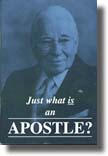
Today we find the Church of God in a “wilderness of religious confusion!”
The confusion is not merely around the Church – within the religions of the world outside – but WITHIN the very heart of The True Church itself!
Read online or contact email to request a copy