ITALY - Italy fears “another Calais” on its border with France as desperate migrants and refugees are thwarted in their bid to cross the frontier and reach northern Europe. Tighter border controls by the French authorities have created a bottleneck around the Italian town of Ventimiglia, just a few miles from the French border. The Italians are trying to transfer migrants and refugees to reception centres in other parts of the country in order to prevent the development of ramshackle camps such as the notorious ‘Jungle’ in Calais and the tent village that sprung up earlier this year at Idomeni, along the border between Greece and Macedonia. “Our border with France will not become another Calais,” Angelino Alfano, the Italian interior minister, told La Repubblica newspaper.
UK - Vladimir Putin and Theresa May have spoken for the first time since she took office and both expressed dissatisfaction with the current state of Russian-British relations.
RUSSIA - Vladimir Putin and Recep Tayyip Erdogan presented a united front at their first meeting since Turkey shot down a Russian plane last year, promising to rapidly rebuild a damaged economic relationship and find a new common policy for solving the Syrian conflict. “We have gone through a very difficult moment in the relationship between our two countries, but now we would all like to overcome it in the interests of both our peoples,” said the Russian president during a joint press conference with his Turkish counterpart in St Petersburg. “We want to restore our relationship not only for pragmatic reasons, but in the long-term interests of our countries, and for the sake of promoting good neighborly relations between Russians and Turks.”
USA - Is the city of Chicago about to see a wave of unprecedented chaos and violence? The facts that I am about to share with you may seem fantastical at first glance, but they come from the Chicago police and they are being reported by the mainstream media. According to authorities, at a recent gathering of major gangs in the city it was agreed that they would use automatic weapons against the police, and at least one of the gangs already has “a sniper in place” but officials do not know where that sniper is located. As I have warned before, a spirit of violence and civil unrest is rising in America, and the number of police officers that were shot and killed during the first half of 2016 was 78 percent higher than during the first half of 2015. Anyone that does not understand that we have a major problem on our hands has simply not been paying attention.
USA - Major media are rushing to do damage control on Hillary’s health. They’re trying to lay down the concrete of a fake consensus that she’s fine, because her doctor issued a positive report in 2015. But one of the bottom lines is: she’s suffered from dangerous blood clots. And the treatment is blood-thinners, which are given to reduce the possibility of a fatal clot.
RUSSIA - The Russian leader is reportedly mounting an enormous military mission to take control of the ISIS terror group’s stronghold of Raqqa. The city is the self-declared capital of ISIS in Syria and is patrolled by as many as 5,000 jihadi members. Putin is set to mobilise 150,000 reservists who he conscripted into the military in September. Following the Paris attacks, Putin hinted he was ready to join forces with the West to tackle Islamic State. He told David Cameron: “The recent tragic events in France show that we should join efforts in preventing terror. I swear if they bomb Russia, in half an hour every Muslim will die” he said.
USA - But hey, who cares? I mean I’ll be dead by the time Social Security implodes. I paid into it. I want my money. That most people take out far more in Social Security than they put in in a lifetime means nothing to me. I was promised Social Security and I am going to get my check. The grand kids can figure it out.
UK - When Max Schrems, an Austrian privacy activist, requested to see his personal data that Facebook stored on its servers, he was mailed a CD-ROM containing a 1,222-page document.
USA - Thirteen percent of US adults tell Gallup they currently smoke marijuana, nearly double the percentage who reported smoking marijuana only three years ago. Although use of the drug is still prohibited by federal law, the number of states that have legalized recreational marijuana use has grown from two in 2013, Colorado and Washington, to four today - with the addition of Alaska and Oregon - plus the District of Columbia. Five states will vote on whether to legalize marijuana this November.
USA - Millions of Americans may be drinking water with unsafe levels of industrial chemicals, according to a study published Tuesday in the journal Environmental Science & Technology Letters. These chemicals, known as polyfluoroalkyl and perfluoroalkyl substances or PFASs, have been linked to high cholesterol, obesity, hormone suppression - and even cancer. Introduced more than 60 years ago, PFASs are a category of man-made chemicals that degrade very slowly, if at all, in the environment.
TURKEY - The Constitutional Court has ruled to annul a provision that punishes all sexual acts against children under the age of 15 as “sexual abuse,” stirring outrage from academics and women’s rights activists who warn that the decision will lead to cases of child abuse going unpunished. The Constitutional Court discussed the issue upon an application from a district court, which complained that the current law does not discriminate between age groups in cases of child sexual abuse and treats a 14-year-old as equal to a four-year-old. With seven votes against six, the Constitutional Court agreed with the local court and decided to annul the provision. The decision will come into effect on January 13, 2017.
ITALY - Polygamy must become a civil right in Italy similar to same-sex civil unions, which the country allowed earlier this year, a prominent Muslim representative has said. “There’s no reason for Italy not to accept polygamous marriages of consenting persons,” Hamza Piccardo, founder of the Union of Islamic Communities and Organizations (UCOII), wrote in a controversial Facebook post last week. “When it comes to civil rights here, then polygamy is a civil right. Muslims don’t agree with homosexual partnerships and still they have to accept a system that allows it,” he stressed. Piccardo’s statements caused uproar in Italy, a mainly Catholic country which still remains divided on the issue of civil unions.
ITALY - A furious Italian MEP has branded the European Union (EU) a failed "oligarchy" and blamed its undemocratic nature for driving Britain out of the exit door. In a scathing outburst Barbara Spinelli said Europe is facing the terrifying prospect of a rerun of the 1930s and the rise of fascism because of the intransigence of Jean-Claude Juncker's EU Commission.
UK - Nigel Farage has warned there will be a major break up of the EU – predicting Denmark, the Netherlands and Sweden are all heading for their own referendums following Brexit. The Ukip leader, who announced his resignation as party leader earlier this month, claimed other countries' attitudes are "very, very similar" to the UK’s about being ruled by Brussels. Speaking at the Republican National Convention in Ohio, Mr Farage said a "European Democrat" movement was forming because people are sick of "surrendering" their democratic rights to the EU. But right across the European continent there are countries whose attitudes towards being governed by Brussels are very, very similar to the British.
"I do think that we are going to see more referendums.”
GERMANY - A string of tragedies in Germany and France has raised identity questions in Europe. An axe attack on a German train, a massacre in Munich, a suicide bombing in a pretty German market town and the murder of an elderly priest at mass in a village in Normandy – all coming after a series of mass-casualty atrocities in Nice, Paris, and Brussels.
Disclaimer:
The views expressed in this section are not our own, unless specifically stated, but are provided to highlight what may prove to be prophetically relevant material appearing in the media.
“Just what is an APOSTLE?”
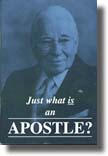
Today we find the Church of God in a “wilderness of religious confusion!”
The confusion is not merely around the Church – within the religions of the world outside – but WITHIN the very heart of The True Church itself!
Read online or contact email to request a copy